As a parent, one of the most important decisions you’ll make is where your child goes to preschool. Preschool can have a big impact on your child’s confidence, curiosity, and future success.
With early brain development happening at rapid rates, it’s important to choose the right learning environment.
These days in Burlington, NC, parents are increasingly turning to play-based preschools.
And they’re not alone. Play-based learning allows children to develop crucial academic, social, and emotional skills through research-backed methods—but in a fun way.
Here’s What You’ll Learn
- What play-based learning is and how it works
- Why it’s beneficial for young children
- How to choose the right program for your child
What is Play-Based Learning?
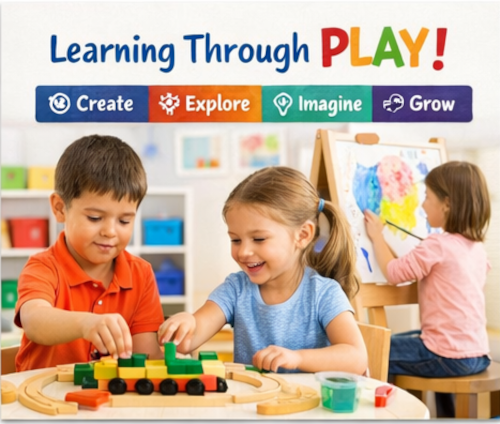
Play-based learning focuses on children learning through hands-on activities, creativity, and structured play instead of textbooks and worksheets.
In a play-based classroom, children learn by:
- Building with blocks
- Engaging in imaginative play
- Exploring different textures
- Playing games in groups
- Learning through music, movement, and stories
These types of activities aren’t just random play.
Teachers carefully plan these activities to ensure children are developing important skills.
When they’re given the opportunity to learn through play, children grow in areas such as:
- Communication
- Problem-solving
- Creativity
- Social skills
Through play, children learn about the world in meaningful ways.
Plus, they have fun building the skills they need to succeed in school.
To learn more about how playful learning supports development, see the National Association for the Education of Young Children’s overview of playful learning and Harvard’s brain-building through play resources.
Benefits of Play-Based Preschool in Burlington
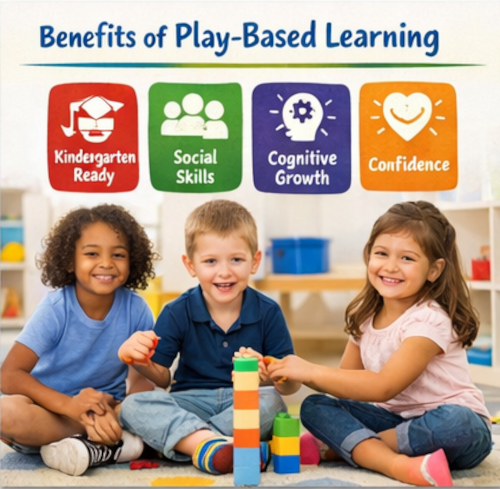
Parents across Burlington, Graham, and Elon care about education. They don’t just want their kids to be watched at preschool.
Parents want:
- Learning
- Kindergarten readiness
- Socialization
- Emotional development
- Confidence
That’s where play-based preschool comes in.
Play teaches children skills like:
- Communication
- Problem-solving
- Creativity
- Motor skills
- Social skills
- Independence
Studies have shown that play can also help with:
- Early literacy
- Early math skills
- Language development
- Social-emotional development
Best of all, play helps children develop critical 21st-century skills like problem-solving, collaboration, and creativity.
Parents can also review North Carolina Pre-K standards and the North Carolina Foundations for Early Learning and Development to better understand how quality preschool supports school readiness.
Play-Based Learning Advantages
1) Kids Develop Cognitive Skills
Children learn by doing.
When kids play, they experiment, ask questions, solve problems, and think critically.
Play allows children to fully engage with their learning. Because of this, play-based learning can have a huge impact on a child’s memory and attention skills.
Harvard’s guide to executive function explains how playful, engaging activities strengthen thinking and self-regulation.
2) They Learn Social & Emotional Skills
School isn’t just about academics. Socialization is just as important.
When interacting with others during play, children learn how to share, make friends, express their feelings, and develop empathy. These social-emotional skills are vital to your child’s success in life.
3) Children Enhance Their Language Skills
Because play-based classrooms encourage storytelling, singing songs, and playing games, children are constantly hearing new words and developing their communication skills, vocabulary, and listening skills.
This sets your child up for reading and writing success down the road.
4) Builds Confidence & Independence
Allowing children to learn through play encourages decision-making. It allows them to learn independently and try new things. Kids who learn through play tend to develop a strong sense of self-confidence.
5) Kids Love Going to Preschool
Play gets kids excited about learning. Instead of viewing school as a place of pressure and stress, your child will see school as a fun, engaging, and rewarding place.
When your child has positive feelings toward learning at a young age, they are more likely to excel later on.
5 Things to Look For In A Play-Based Preschool
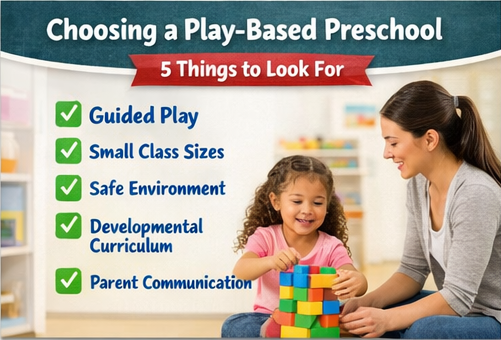
✅ 1. Guided Play vs. Free Play
While free play is important, children also need structured learning. Look for preschools that include guided activities in their daily schedule.
✅ 2. Low Teacher-to-Child Ratios
Small classes allow for more individualized attention, better teacher-student relationships, and higher-quality learning.
✅ 3. Clean Facility, Secure Environment
Whenever you visit a potential preschool, look at how clean and organized it is. A safe and well-maintained environment is crucial for your child’s learning.
✅ 4. Curriculum Focused On Children’s Development
Good preschools have lesson plans that support language, social, and motor development while encouraging problem-solving and logical thinking.
✅ 5. Communication With Parents
Great preschools keep families informed through daily updates, weekly reports, and open communication.
Play-Based Preschools Are Becoming Popular In Burlington
Ask any parent in Burlington, Graham, or Elon what they want for their child and you’ll hear:
“I just want my child to feel confident and be ready for kindergarten.”
Parents want their kids to be learning, but they don’t want them to lose that sense of curiosity that all children naturally have.
They want a program that combines learning, social development, and fun. That’s where play-based preschool stands out.
Play-Based Preschool vs Traditional Preschool
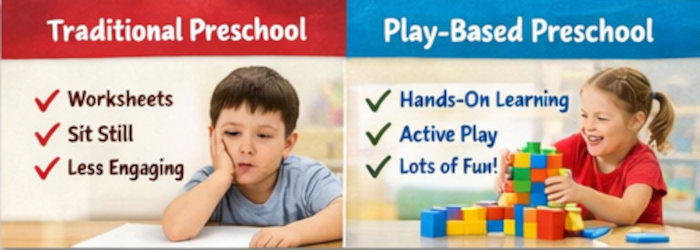
| Traditional | Play-Based |
|---|---|
| Worksheets | Hands-on learning |
| Passive | Interactive |
| Rigid | Flexible |
| Less engaging | Highly engaging |
Parents Know Preschool Should Be More Than Just Sitting at a Desk
Learning comes naturally to kids. It’s when schools force them to sit down at a desk that learning stops becoming fun.
When preschools utilize developmentally appropriate practices and focus on your child’s growth, children begin to:
- Love learning
- Want to go to school each day
- Look forward to seeing their teacher
This is why parents across Burlington are moving away from traditional preschools and toward play-based programs.
Why Little Thinkers Daycare Stands Out
If you’re looking for a play-based preschool in Burlington, Little Thinkers Daycare is designed with your child’s development in mind.
We focus on:
- ✔ Play-based learning that builds real skills
- ✔ Small class sizes for personalized attention
- ✔ Safe, clean, and structured classrooms
- ✔ Programs from infants to preschool
- ✔ A nurturing environment where children thrive
Our goal is simple:
Help every child grow, learn, and succeed—with confidence.
Explore more about our preschool program, our infant program, our teaching philosophy, our staff, and our schedule.
Schedule a Tour Today
The best way to choose the right preschool is to see it for yourself.
Come experience the difference a play-based learning environment can make.
Final Thoughts
Play-based learning is more than a trend—it’s a proven approach that supports how children naturally learn and grow.
For families in Burlington, Graham, and Elon, choosing a preschool that prioritizes creativity, exploration, social development, and confidence can set the foundation for lifelong success.
Because at the end of the day: Play isn’t just fun—it’s how children learn best.
FAQ
What is play-based learning?
Play-based learning is an approach where children learn through guided play, hands-on activities, and social interaction.
Is play-based preschool better?
For many children, yes. Research shows it supports cognitive, social, emotional, and language development while helping children build confidence and a love for learning.
What is the best preschool in Burlington, NC?
Look for programs with structured play, small class sizes, strong teacher-child relationships, and a development-focused environment—like Little Thinkers Daycare.
